
Back to the Future: How relevant is Aristotle’s description of the birth of Democracy in ancient Athens, today?
Three centuries after the the application of Solon's laws in ancient Athens, Aristotle gives as a comprehensive review of the general context around the birth of the first model of Democracy. Today, two and a half millennia later, within a global environment where the survival of real Democracy comes into question, it is important to revisit this critical approach of its birth as a stepping stone towards its rescue.
Andrianos Charalambous
6/25/20268 min read
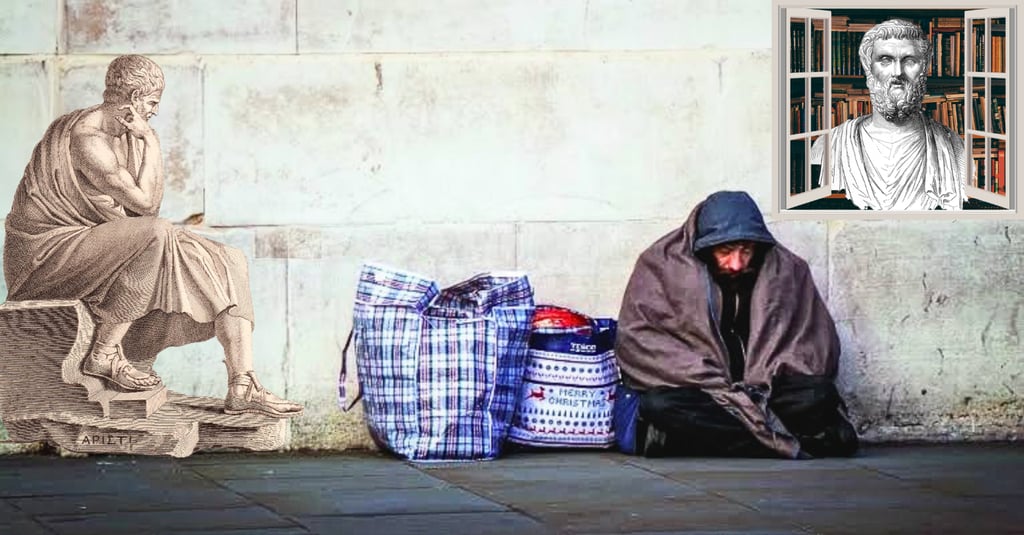

More than 2,500 years ago, Athens faced a crisis that would sound remarkably familiar to citizens of many contemporary democracies. Economic inequality was growing, political power was concentrated in the hands of a privileged elite, public trust in institutions was eroding, and social divisions threatened the stability of the state itself. The wealthy appeared increasingly detached from the struggles of ordinary citizens, while large segments of the population felt excluded from meaningful participation in political life.
According to Aristotle's The Constitution of the Athenians, Athens stood at the edge of internal collapse. A rather grim testament to this are the relatively recent findings of 79 people that are considered to have been executed due to their role in the rising political tensions of the 7th century B.C. Yet from this crisis emerged one of history's most significant political transformations: the reforms of Solon, the statesman who laid the foundations for what would eventually become the world's first democracy.
Although separated by millennia, Aristotle's account of Athens before and after Solon offers profound insights into the challenges confronting democratic societies today. The story is not merely a historical narrative. It is an enduring lesson about inequality, political legitimacy, institutional trust, and the delicate balance upon which democratic governance depends.
Democracy's Forgotten Origins
Modern observers often imagine Athens as the birthplace of democracy, but Aristotle reminds us that democracy did not emerge suddenly. Before Solon, Athens was governed by a narrow aristocratic elite known as the Eupatridae, the "well-born."
Political power was concentrated in the hands of a small number of noble families who controlled public offices, courts, and legislative institutions. Although Athens was no longer a monarchy, the practical reality was that government remained the domain of hereditary elites.
The Areopagus, composed of former magistrates, served as one of the most powerful institutions in the city. Since only aristocrats could realistically attain these offices, the council became a mechanism for preserving elite influence across generations.
For ordinary Athenians, political participation was limited. Decisions affecting the entire community were made by a privileged minority whose interests often diverged from those of the broader population.
This concentration of power bears striking similarities to concerns voiced in many modern democracies. While contemporary political systems provide universal suffrage and formal equality before the law, critics increasingly point to the disproportionate influence of economic elites, corporate interests, powerful lobbying groups, and entrenched political establishments.
The forms have changed, but the underlying question remains remarkably similar: who truly governs?
The Economic Roots of Political Crisis
Aristotle emphasizes that Athens' constitutional crisis was fundamentally linked to economic inequality.
Many small farmers struggled under heavy debt burdens. Loans were often secured against the person of the borrower, meaning that failure to repay could result in debt slavery. Citizens who lost their freedom could be forced to work for creditors or even sold abroad.
As wealth accumulated among landowning elites, growing numbers of Athenians experienced insecurity, dependence, and exclusion.
The result was a dangerous polarization between rich and poor. The wealthy sought to maintain existing privileges, while the poor increasingly demanded relief and reform. Athens was entering a period of stasis—a condition of social conflict, factionalism, and political instability.
The parallels with contemporary societies are difficult to ignore. Today, debt no longer leads directly to slavery, yet economic dependence continues to shape political realities. Rising housing costs, debt, precarious employment, stagnant wages, environmental crimes and widening wealth gaps have produced growing frustration across many democratic states.
In much of Europe and North America, younger generations increasingly question whether existing political systems can provide the economic security enjoyed by previous generations. Home ownership, stable employment, and social mobility appear less attainable than they once did. As in Athens, economic grievances frequently evolve into political grievances. Citizens who feel economically marginalized often conclude that institutions no longer represent their interests.
The lesson from Aristotle is clear: political stability cannot be separated from economic legitimacy.
Solon and the Politics of Reform
Faced with mounting tensions, Athenians appointed Solon as mediator and lawgiver. What makes Solon particularly significant is that he rejected both revolutionary upheaval and elite intransigence. He sought neither to overthrow the wealthy nor to preserve the status quo unchanged. Instead, he pursued reform.
His most famous measure, the Seisachtheia or "Shaking Off of Burdens," abolished debt slavery, cancelled many existing debts, liberated citizens who had lost their freedom, and prohibited future loans secured against the body of the borrower. These reforms addressed the immediate causes of social unrest while preserving the broader constitutional order.
Solon understood a principle that remains essential for modern democracies: institutions survive only when citizens believe they operate fairly. Governments that fail to address widespread social grievances may preserve legal authority for a time, but they gradually lose political legitimacy.
This lesson resonates strongly today. Across democratic societies, debates about housing affordability, economic inequality, social and environmental protection, healthcare access, and educational opportunity are ultimately debates about legitimacy. Citizens expect democratic institutions not merely to administer society but to ensure that opportunities and burdens are distributed in ways perceived as fair.
The Expansion of Political Participation
Perhaps Solon's most important contribution was not economic but political. He weakened the monopoly of hereditary aristocracy by linking political eligibility to property rather than noble birth. More significantly, he expanded participation in public institutions and strengthened the role of ordinary citizens in the judicial system. Yet, this is a perfect opportunity to comprehend that democracy in ancient Greece, even at its best, was not democracy as we understand and strive for today. Even here -at its best- it only considers citizens the ones that possess property. But really, how different is that to today’s realities?
The real power was access to justice! Citizens gained the right to appeal decisions made by magistrates. Popular courts became an increasingly important source of political authority. Aristotle later argued that this judicial empowerment became one of the foundations of Athenian democracy. Once citizens gained meaningful mechanisms for oversight and accountability, they gradually acquired influence over the constitutional order itself.
The “Cylonian Conspiracy” is an incident that highlights the importance law and justice had for the Athenians. It serves almost as a parable towards the means of the importance to follow the law today to whomever it may apply in every case - even towards the enemy or towards a criminal. The law demanded respect to the temples as asylums and did not allow the attack on anyone that would seek refuge in them. Athenians in the case of Cylon and his army disrespected the law and faced severe consequences by the gods. For citizens to have access to a god-protected set of laws was deemed fair for the first time and it changed social cohesion forever.
The modern equivalent is the principle of institutional accountability. Independent courts, constitutional review, parliamentary oversight, free media, anti-corruption bodies, and civil society organizations all perform functions similar to those envisioned by Solon's reforms. They provide citizens with mechanisms to challenge authority and hold public officials accountable. When these institutions weaken, democracy itself becomes vulnerable.
Recent debates concerning judicial independence, attacks on the media and at the same time lack of independence in their sector, declining trust in public institutions, and challenges to the rule of law demonstrate how central accountability remains to democratic governance. Like in the Cylonian Conspiracy, it reminds us that the people that are responsible to upkeep the law are simultaneously responsible for the fate of the society.
The Danger of Polarization
One of the most striking aspects of Aristotle's account is that Solon's reforms did not immediately resolve Athens' divisions. The wealthy believed he had gone too far. The poor believed he had not gone far enough. Both sides criticized him. Yet Aristotle regarded this outcome as evidence of political wisdom. Solon's objective was not to satisfy one faction but to preserve the political community as a whole.
Modern democracies face a similar challenge. Political polarization has intensified across much of the democratic world. Parties increasingly define themselves through opposition to their rivals rather than through shared commitments to constitutional norms. Public discourse often rewards confrontation over compromise. In such environments, moderation is frequently portrayed as weakness. It is again important to note here that in the 7th century B.C. people were struggling for the birth of Democracy - today we are struggling with its conservation. Two vastly different goals that call for different stances.
Yet Aristotle suggests the opposite. Durable democracies depend upon institutions capable of mediating competing interests rather than delivering total victory to one side. The stability of a democracy depends less on consensus than on the ability to manage disagreement peacefully or to attribute more rights and freedoms to the general population - however fair that may be. And here lies my main disagreement with Aristotle and Solon as well, because justice must not be based on math but ethos. What is considered “fair”, should not be measured as a balance between the previous condition and the new ones, but as a vision towards complete and resolute justice. But again, this was 2600 years ago…
From Democratic Frustration to Populist Leadership
Despite Solon's efforts, Athens eventually witnessed the rise of the tyrant Peisistratus. Importantly, Aristotle explains that Peisistratus did not emerge despite social divisions but because of them. He exploited existing grievances, presented himself as the defender of ordinary citizens, and used political instability to consolidate personal power. This pattern remains familiar. This is what we call “populism”.
Across contemporary democracies, populist leaders often emerge during periods of declining trust in institutions, economic anxiety, and political polarization. They present themselves as outsiders capable of bypassing ineffective systems and speaking directly on behalf of "the people."
Aristotle's analysis suggests that populism is often less a cause of democratic crisis than a symptom of deeper structural problems. When institutions fail to address public grievances, citizens become more receptive to leaders promising extraordinary solutions. I shall add to that, that when institutions fail to equip citizens with the proper knowledge, understanding and moral compass, they lay the foundation for public conscience exploitation by populists.
The Central Question of Democratic Legitimacy
At the heart of Aristotle's account lies a simple but profound insight: no political system can remain stable if a large portion of its citizens believe it serves only a privileged minority.
The crisis of pre-Solonian Athens was not merely economic or constitutional. It was a crisis of legitimacy. Citizens no longer trusted that institutions reflected the interests of the broader community. Solon's achievement was not the creation of democracy itself but the restoration of confidence that political institutions could be reformed to serve the common good. This remains the defining challenge of contemporary democracy.
Citizens may disagree about policies, parties, ideologies, or leaders. What ultimately sustains democratic systems is the belief that institutions remain responsive, accountable, and capable of adaptation. When that belief weakens, democracy enters dangerous territory.
Conclusion: Aristotle's Warning for the Modern Age
The story of Athens before and after Solon is not merely a chapter in ancient history. It is a case study in how societies confront inequality, political exclusion, and institutional decline.
Aristotle shows that democracy did not emerge from idealism alone. It emerged from the practical recognition that societies cannot endure when power becomes excessively concentrated, when economic disparities become politically destabilizing, and when citizens lose faith in the fairness of public institutions.
The relevance of this lesson is perhaps greater today than at any time in recent decades. Across the democratic world, citizens express growing concerns about inequality, elite influence, political polarization, institutional trust, and democratic accountability. These concerns differ in form from those of ancient Athens, yet they arise from remarkably similar tensions between power, participation, and legitimacy.
Solon's enduring contribution was not simply a set of laws. It was the recognition that stable government requires continual adaptation to changing social realities. It was a perfect warning that Capitalism cannot coexist with real Democracy. Democracy survives not because institutions are perfect, but because they respect their responsibilities, and remain impartial, impervious and capable of reform.
That was Aristotle's lesson for Athens.
It shall also serve as his lesson for us.